There is a specific quality to the light in Portugal. It’s a luminous, honey-golden thing, especially in the late afternoon when the dust motes dance in the sunbeams slicing through ancient windows. I’ve spent a decade chasing that light across continents, from the frenetic energy of Tokyo’s alleys to the silent, snow-capped peaks of Patagonia. But there are days when the most profound journey isn’t measured in miles, but in the sheer, breathtaking weight of history pressing down on your shoulders. This was one of those days.
I had heard whispers of a place just outside Lisbon, a monument so audacious, so overwhelmingly grand, that it threatened to swallow the very town it was built to protect. They called it the "Portuguese Versailles." They called it a "stone symphony." But nothing prepares you for the reality of the Mafra National Palace.
As the bus rattled away from the frenetic pulse of the capital, the urban sprawl gave way to rolling hills dotted with cork oaks, their bark stripped and bleeding orange beneath the relentless sun. The air began to smell different—less of exhaust and more of eucalyptus and damp earth. And then, rising above the treeline like a mirage, it appeared. A colossal white façade, stretching so far left and right that my eyes struggled to find the edges. It didn't look like a palace; it looked like a city wall dedicated to the gods of opulence.
The Genesis of a King’s Obsession
To understand Mafra, you have to understand the man who willed it into existence: King D. João V. In the early 18th century, Portugal was riding the wave of immense wealth flowing from its colonies in Brazil, specifically the discovery of gold and diamonds. D. João was a monarch of immense appetites—for power, for art, for pleasure—and for an heir.
After years of barren silence from his wife, Queen Maria Anna of Austria, a desperate pilgrimage was made to the Shrine of Our Lady of Conimbriga. A vow was made: if a son was granted, a magnificent convent would be built. In 1711, the Infante D. José was born. The vow had to be paid, but D. João, never a man for half-measures, decided the convent would be something the world had never seen.
He summoned the Italian architect João Frederico Ludovice, a man who had absorbed the lessons of Rome and brought them to the banks of the Tagus. The original plan was for a modest Franciscan convent. It quickly spiraled into an obsession. The estimated cost ballooned to a staggering one-third of Portugal's annual colonial revenue. It was a statement. It was a flex. It was the Baroque era in its most concentrated, unapologetic form.
The Exterior: A Lesson in Scale
I arrived in the town of Mafra, a charming place that seems perpetually in the shadow of its gigantic neighbor. The address is simple enough: Largo D. João V, 2640-512 Mafra, Portugal.
Before you even step inside, the exterior commands a walkaround. The North façade faces the town, a rhythmic cascade of baroque and rococo style, punctuated by statues of saints. But it is the South façade, facing the vast Jardim do Alecrim (Rosemary Garden), that truly takes your breath away. It stretches 219 meters (about 720 feet). To put that in perspective, that’s longer than two American football fields placed end-to-end.
I stood there, a tiny speck of humanity, gazing up at the 58-meter-high towers. The façade is a symphony in limestone, softened by time and the salty Atlantic air. It feels less like a building and more like a geological formation, something that should have eroded over centuries but stands defiant. The sheer audacity of it is humbling. It’s the architectural equivalent of shouting from a mountaintop.
Essential Visitor Info
Location: Main Entrance, Largo D. João V, Mafra.
Hours: Typically 10:00 AM to 6:00 PM. Closed on Mondays. (Check Parques de Sintra - Monte da Lua website for seasonal changes).
Admission: Standard tickets €12-€15. Combination tickets available for the Convent and Basilica.
The Threshold: Crossing into the Royal Realm
The entrance is located on the North façade. The ticket office is a brief, modern intrusion before you step back into the 18th century. The moment you cross the threshold, the world changes. The noise of the wind and the distant traffic vanishes, replaced by a hushed, reverberating silence. You are standing in the Corte dos Milagres (Courtyard of the Miracles), named for the miraculous birth of the heir. The scale here is intimate yet imposing, framed by the colossal church towers.
The Library: A Whisper of Vellum and Leather
But the real secret, the heart of the palace, lies hidden within the walls. You walk through the Grand Gallery, a hallway of mirrors intended to rival Versailles, stretching 47 meters. It is magnificent, filled with Portuguese furniture and paintings by the likes of Vieira Portuense. Yet, my footsteps echoed, and I felt the pull of something quieter, something older.
I pushed open the heavy doors to the Biblioteca (Library). Oh, the library.
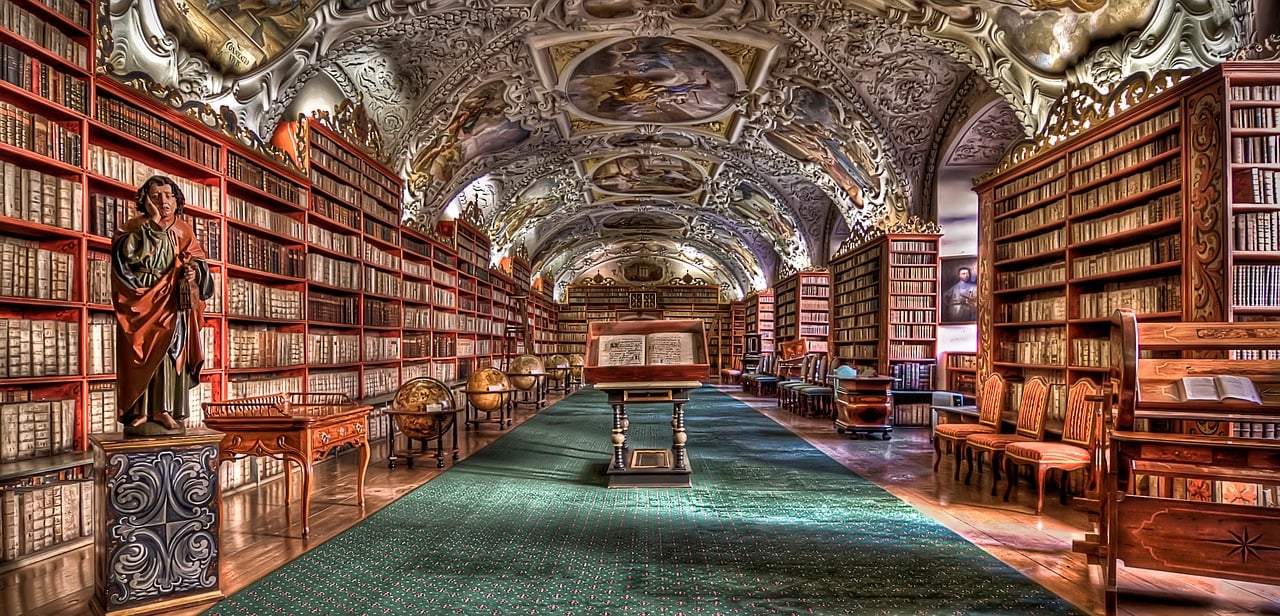
If you come to Mafra for nothing else, come for this room. It is 88 meters long, lined with floor-to-ceiling mahogany shelves carved in a stunning Rococo style. The ceiling is covered in magnificent frescoes by Dominique Vivien, a French artist who painted these illusions of architecture and open sky while lying on his back on scaffolding for years. The frescoes depict allegories of the sciences and the arts.
But the magic is in the air. It smells of old paper, leather, and beeswax. This library houses over 36,000 rare books, collected by King D. João V and added to by later monarchs. It is a pristine collection of incunabula (books printed before 1501), atlases, and manuscripts.
The Royal Secret: Architectural Genius
As I walked slowly down the center, I noticed something odd. The floor wasn’t wood; it was a mosaic of limestone and marble. It was designed to be slightly slanted, with small gaps between the tiles. Why? It was a clever ventilation system to protect the books from the damp Portuguese climate. It was a genius solution hidden beneath a beautiful surface—a perfect metaphor for the palace itself.
The Hunting Rooms and the King’s Private Life
Moving deeper into the labyrinth, you leave the public face of the palace and enter the private quarters. The Salas de Caça (Hunting Rooms) are a revelation. The walls are entirely covered in azulejos (painted ceramic tiles) depicting hunting scenes—stags, dogs, and hunters in vibrant blues, yellows, and greens. It’s immersive, almost dizzying.
I sat on a velvet bench, looking at the intricate tile work. It’s easy to forget that this was a home. This is where the "Royal Secrets" come alive. Behind the gilded doors are the Royal Apartments.
In the Queen’s Bedroom, the bed is a tiny, gilded cage. It’s shockingly small by modern standards, draped in heavy, dark fabrics. I peered at the intricate embroidery, imagining the queen sleeping there, surrounded by ladies-in-waiting and the constant pressure of court life. The room feels stifling, yet beautiful.
Adjacent is the King’s Room, slightly more imposing. Here, you can feel the presence of D. João V. He was a man who loved spectacle. The palace wasn't just a residence; it was a stage. He built a private theater here, one of the oldest in Europe, still in perfect working order. The mechanics of the stage, the fly systems, the painted backdrops—they are all original 18th-century technology.
The Basilica: A Jewel in the Crown
You cannot separate the Palace from the Basílica de Nossa Senhora e de Santo António. It is physically attached to the palace, connected via a corridor. In fact, the Royal Family had a private balcony overlooking the basilica’s nave, allowing them to attend mass without mixing with the commoners.
The basilica is a masterpiece of Italian Baroque. While the exterior is relatively austere, the interior explodes with gold. The high altar is a riot of gilded woodwork (carved wood, not solid gold, though it looks it). The columns are made of grey Estremoz marble, the floor of coloured marble mosaics.
But the acoustics... that’s the secret weapon. I arrived just as a brief organ recital was finishing. The sound didn’t just fill the room; it became the room. It vibrated in your chest. The church houses the Cenotaph of King D. João V, a masterpiece by the sculptor Joaquim Machado de Castro. Even though the King is buried elsewhere, this monument captures his power and majesty perfectly.
The Convent: The Franciscan Soul
Most tourists stick to the main palace. But to truly understand the site, you must visit the Convent (Convento). It is accessed through the palace or via a separate entrance, located at Largo D. João V. The convent is a stark contrast to the royal opulence. It is a place of discipline, silence, and prayer.
You walk through the Cloisters, quadrants of calm surrounded by simple arches. The monks' cells are spartan, containing just a bed, a crucifix, and a window looking out onto the gardens.
The most poignant part is the Refectory. The walls are tiled with blue and white azulejos depicting scenes from the life of Saint Francis of Assisi. In the center, the monks sat at a long table. Above, on a raised platform, a monk would read from the Bible while the others ate in silence. It is a room that demands you lower your voice. It feels heavy with the weight of thousands of hours of silent devotion.
The Tiled Kitchen: A Feat of Engineering
One of the most fascinating "secrets" of the Mafra complex is the Cozinha (Kitchen). Located in the convent wing, it is a cathedral of culinary engineering. It features a massive set of copper pots and a complex ventilation system that still works. But the star is the Tiled Floor. It is paved with magnificent 18th-century azulejos depicting aquatic scenes—fish, crustaceans, and sea monsters. It’s a whimsical, surreal touch in a utilitarian space. It reminds you that even for the monks, beauty was a form of worship.
The Hunting Grounds: Tapada de Mafra
If your legs haven’t given out yet, there is one more layer to the Mafra experience. The Tapada de Mafra (Mafra Hunting Grounds) is a vast wall-enclosed park (1,200 hectares) just a short drive or a 20-minute uphill walk from the palace.
Address: Estrada da Tapada, 2640-516 Mafra.
Hours: Generally 9:00 AM to 6:00 PM (closed Mondays).
Activity: Hiking, biking, or guided jeep tours. Look out for local deer and birds of prey.
This was the King’s private playground. Today, it’s a sanctuary of cork oaks and holm oaks. Standing at the top of the hills, looking back at the Palace dominating the horizon, you get a sense of the sheer scale of the royal domain. It was a kingdom within a kingdom.
Practicalities for the Modern Pilgrim
Visiting Mafra is a full-day commitment. It is not a "pop-in" attraction.
- Getting There: The easiest way is by car, which gives you the freedom to explore the Tapada and nearby Ericeira. However, public transport is viable. Take the Caminhos de Ferro Portugueses (Comboios de Portugal) train from Lisbon’s Oriente or Entrecampos stations to Mafra. The station is about a 20-minute walk from the palace.
- Timing: The morning light hits the North façade beautifully. However, the afternoon sun illuminates the South façade and the gardens. I recommend arriving at 10:00 AM, doing the Palace first (2-3 hours), lunch in the town, and then the Convent (1 hour).
- Dining: Don’t eat at the tourist traps right next to the palace gates. Walk two blocks into the town center. Look for a tasca serving Bacalhau à Brás (shredded cod with onions, straw fries, and egg) or Leitão (suckling pig), a regional specialty. The local wine, Colares, is a bracing, salty white that pairs perfectly.
The Lasting Impression
As the day faded, the sky turned that bruised purple of twilight. I sat on the steps of the Basilica, watching the locals stroll by with their dogs. The palace was no longer a looming giant but a warm, glowing presence.
The "secrets" of Mafra aren't just the hidden rooms or the architectural tricks. The real secret is how it manages to be both a monument to absolute power and a deeply human place. It is a testament to a king’s love for his wife and a desperate desire for an heir. It is a testament to the thousands of workers—masons, carpenters, artists, and monks—who poured their lives into these stones.
It is UNESCO listed not just because it is beautiful, but because it represents a specific moment in time when the Baroque spirit reached its zenith on the edge of Europe. It is a stone symphony that still plays a haunting melody for anyone who stops to listen. And as I walked back to the bus, the image of that library—silent, golden, and eternal—was burned into my mind. It was a treasure house of knowledge and beauty, hidden in plain sight, waiting to be discovered.