
The Dream of a Sun-Kissed Future: An Ultimate Guide to Valencia’s City of Arts and Sciences
There is a specific quality of light in Valencia that I have never quite found anywhere else. It is a Mediterranean light, certainly, but here it seems to possess a physical weight, a golden density that pools in the streets and bounces off the white ceramic tiles of the historic center. But if you walk eastward from the ancient labyrinth of the Barrio del Carmen, past the grand bulk of the Torres de Serranos, and follow the Turia riverbed—a garden that flows like a green artery through the city’s heart—you will eventually see it rise against the horizon.
It begins as a glint of blue and white, a shard of impossible geometry piercing the sky. Then, as you get closer, it unfolds into a landscape that feels less like architecture and more like a terraformed slice of the 23rd century dropped gently into the Iberian sun. This is the City of Arts and Sciences (Ciudad de las Artes y las Ciencias). Designed by native son Santiago Calatrava and his partner Félix Candela, it is a complex that defies simple categorization. It is a museum, an aquarium, a theater, a park, and a philosophy all rolled into one.
I remember my first visit vividly. I was jet-lagged and slightly grumpy, having walked for miles in the oppressive August heat. I expected a monument of concrete and glass—cold, imposing, alienating. Instead, as I stepped onto the pedestrian bridge, the Puente de l'Assut d'Or, I felt a sudden rush of cool air coming off the water. I heard the splash of fountains and the laughter of children. I realized then that this "utopian" vision is actually incredibly human. It is a playground for the imagination.
If you are planning a trip to Valencia, the City of Arts and Sciences is likely at the top of your list. It is the city’s modern icon, a testament to what happens when you let an architect dream with an unlimited budget and a desire to break every rule in the book. But navigating this complex can be overwhelming. There are five main buildings, countless exhibits, and logistical hurdles that can trip up the unprepared. This guide is designed to be your companion, your insider whisper, to experiencing the City of Arts and Sciences not just as a tourist checking off a list, but as a traveler engaging with one of the most ambitious cultural projects of the last century.
The Eye of Knowledge: L’Hemisfèric
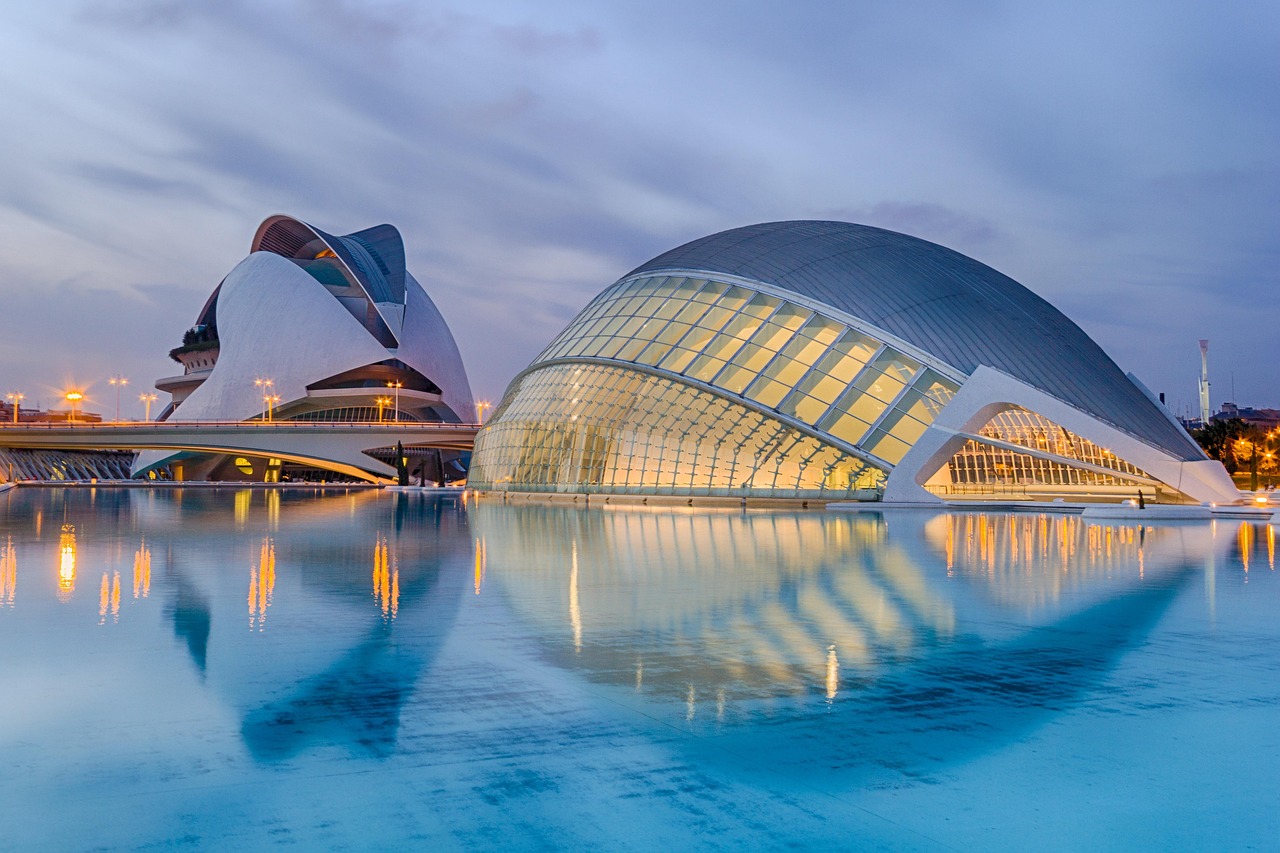
Your journey should begin at the Eye. L’Hemisfèric is the first building you encounter, and it sets the tone for everything that follows. Architecturally, it is a masterpiece of symbolism. It is designed to resemble a giant human eye, complete with an eyelid that can actually open and close. When the eyelid is open, the building looks like a colossal pair of glasses resting on the water. Santiago Calatrava intended for it to be a "receptacle for knowledge," a place where the universe is projected onto a dome for the human eye to digest.
Walking toward it, you cross the Puente de la Aurora, a bridge that feels like walking on the back of a whale. The structure is made of white concrete, which gleams blindingly under the Valencia sun. The entrance is via the "pupil," a walkway that dips beneath the water level, creating a sensation of entering the mind itself.
Inside, the main attraction is the Laserium and the IMAX theater. The dome is one of the largest in the world. I have sat there watching documentaries about the deep ocean or the far reaches of the galaxy, feeling the rumble of the surround sound through my seat. There is a moment, usually when the camera dives into a coral reef or flies through a nebula, where the boundaries of the screen dissolve. You aren't watching the universe; you are floating in it.
Visitor Note
The programming is specific. You cannot just wander around the interior for hours. You buy a ticket for a specific show. The "eye" itself is the projection room. The experience is immersive but regimented. It is spectacular, but it is a passive experience compared to the interactive nature of the building next door.
The Museum of the Future: El Museu de les Ciències Príncipe Felipe
If L’Hemisfèric is the eye, the Príncipe Felipe museum is the brain. It is a staggering building, stretching 220 meters along the water’s edge. It looks like the skeleton of a whale, or perhaps the ribcage of a prehistoric leviathan. There are no straight vertical walls here; the structure is a lattice of white steel and glass that creates a sense of movement even when standing still.
This is not a museum of dusty artifacts behind glass. It is a science museum designed for the 21st century. The core philosophy here is "touch, feel, and experiment." My most enduring memory of the Príncipe Felipe involves a rainstorm. I ducked inside the massive atrium just as the heavens opened. The interior is cavernous, echoing with the sounds of school groups and families. I found myself standing beneath the "Brain," a massive suspended structure that represents the neurons of the human mind. It was lit with changing colors, pulsating with energy.
Interactive Exhibits and Highlights
The exhibits here are world-class. One of the permanent exhibitions is "The Vertigo of the Void," which explores the laws of physics through acrobatic demonstrations. There is a Tesla coil demonstration that is equal parts terrifying and educational. Another section focuses on the evolution of life, featuring a full-sized reproduction of a blue whale skeleton suspended in the main hall.
But the highlight for many is the "Space" exhibition. This is a tribute to the Spanish astronaut Pedro Duque, but it is accessible to anyone with a passing interest in the cosmos. You can step inside a replica of the MIR space station, experience the sensation of walking on the moon (with 1/6th gravity), or try your hand at docking a spacecraft simulator. It is easy to spend three or four hours here just wandering from one interactive station to another. It is also incredibly humid inside, as the climate control mimics a tropical environment for the biodiversity section, so dress accordingly.
The Underwater Kingdom: L'Oceanogràfic
If you only have the time or budget for one attraction in the City of Arts and Sciences, make it L'Oceanogràfic. It is the largest aquarium in Europe, and it is nothing short of a miracle. The architectural concept here is a "Water Lily," with distinct buildings representing different ecosystems, connected by underwater tunnels.
I have visited aquariums all over the world—Atlanta, Singapore, London. None compare to the sheer scale and design of L'Oceanogràfic. The journey begins at the entrance plaza, with its aggressive fountains (the water jets shoot incredibly high and fast—watch your shoes!). You then descend into the "Atlantic," "Pacific," "Arctic," and "Mediterranean" zones.
Marine Life and Architecture
The Mediterranean tank is a highlight of local pride. It is a massive volume of water filled with local species: giant sea bass, groupers, and sturgeon. It feels like swimming alongside the rocky coves of the nearby coast. But the true showstopper is the "Tunnel." It is a 35-meter-long underwater tunnel that moves you through a shark tank. You are surrounded on all sides by sand tiger sharks, bull sharks, and sawfish. It is a moment of pure primal awe. The sharks drift overhead, their eyes blank and ancient, while rays glide like flying carpets.
However, the true soul of L'Oceanogràfic is the Dolphinarium. It is the only one in Spain that houses bottlenose dolphins. The shows are controversial, yes, but the facility is state-of-the-art and the pool is vast. I sat in the front row for a late afternoon show. The sun was setting, casting long shadows across the water. When the dolphins leaped, catching the last rays of light, the crowd gasped in unison. It was a moment of pure kinetic beauty.
There is also a separate building dedicated to the Arctic, which houses beluga whales (a rarity in Europe) and penguins. It is kept at a freezing temperature; you can feel the cold air blasting out of the vents even from the outside. Stepping inside is a shock to the system, a sudden escape from the Valencian heat. Watching the belugas swim is like watching ghosts dance; they are pure white, incredibly agile, and hauntingly vocal.
The Architecture of the Grounds: Palau de les Arts Reina Sofía & Umbracle
You cannot talk about the City of Arts and Sciences without acknowledging the spaces between the buildings. They are as important as the structures themselves. The complex sits on 86 hectares (212 acres), and the landscaping is a work of art.
The Palau de les Arts Reina Sofía is the opera house and performing arts center. It looks like a futuristic helmet or a conquistador's helmet resting on the ground. The roof is made of glass and steel. Even if you don't catch a performance (operas, ballets, symphonies), you should walk around it. The acoustics are said to be world-class. There is a viewing platform at the top of the structure that, on clear days, offers a panoramic view of the entire complex and the city beyond.
Then there is the Umbracle. This is my favorite spot for a quiet moment. It is a landscaped walkway and garden that runs parallel to the main complex. It is designed as a "gardens of the Mediterranean." It features over 50 species of plants: pomegranate trees, palm trees, aromatic lavender, and rosemary. Walking under the arches of the Umbracle, you are shaded from the sun, surrounded by the scent of herbs, with the fountains of the complex playing in the distance.
At night, the Umbracle transforms. It becomes the entrance to the "Askua" nightclub, but during the day, it is a serene place to sit on a bench and watch the world go by. I once spent an hour there sketching the curve of the Hemisfèric, listening to the wind rustle the palm fronds. It is the perfect counterpoint to the high-tech intensity of the museums.
Practicalities: How to Survive and Thrive
Visiting the City of Arts and Sciences requires strategy. It is not a casual drop-in spot; it is a day trip in itself. Here is the hard-won wisdom from my visits regarding things to do in Valencia City of Arts and Sciences.
The Ticket Strategy
There are three main tickets you can buy: The "Space" (Hemisfèric), the "Biodiversity" (Oceanogràfic), and the "Science" (Príncipe Felipe) tickets. You can also buy a "Combos" ticket, which gives you access to two or three buildings.
- My Advice: Do not try to do all three in one day. It is physically impossible to do them justice. The Oceanogràfic alone takes 4-5 hours. The Príncipe Felipe takes 3-4 hours. If you try to rush both, you will end up exhausted and miserable. Pick one major museum and the aquarium, or spend two days in the complex if you are a science geek.
Getting There
The complex is located just east of the city center.
- Bus: Lines 13, 14, 15, 35, and 23 all stop near the complex.
- Metro: The closest station is Alameda (Lines 3 and 5), which is about a 10-minute walk through the Turia park.
- Bike: Valencia has an excellent bike lane system. You can rent a city bike (Valenbisi) or from a private shop and ride right up to the entrance. It is flat and scenic.
Food and Drink
There are places to eat inside, but they are expensive and crowded. The cafeteria at the Príncipe Felipe is decent but pricey. The Oceanogràfic has a restaurant called Restaurante L'Oceanogràfic (located inside the complex, near the entrance), which is actually quite good. It offers a menu with rice dishes (paella) and fresh fish, with tables overlooking the water. It is a great way to break up the day. However, for a cheaper, more authentic option, I recommend packing a picnic. You can eat in the Turia gardens just across the bridge, or find a spot in the Umbracle (if allowed).
Accessibility
The complex is modern, which means it is generally very wheelchair friendly. The ramps are gentle, and the elevators are large. The Oceanogràfic has accessible routes, though some of the underwater tunnels can get crowded. The Príncipe Felipe is fully accessible. The Hemisfèric has specific seating for wheelchair users. If you have mobility issues, you will have a much easier time here than in the historic Old Town.
The "Is it Worth It?" Question
I have seen this debated on travel forums. Some call it "overpriced" or "soulless." I disagree. Yes, it is expensive. Yes, it is a tourist magnet. But the sheer audacity of the architecture and the quality of the exhibits make it worth the price of admission. It is not just a collection of buildings; it is a statement. It says that science and art are vital, that they deserve to be celebrated in grand, beautiful spaces. It is a place that inspires children to look at the stars and the oceans with wonder. That is worth paying for.
The Magic of the Blue Hour
As the day winds down, the City of Arts and Sciences undergoes its final transformation. This is the "Blue Hour," that fleeting period after sunset when the sky turns a deep, velvety indigo.
The complex is illuminated from within and without. The white concrete glows. The water reflects the lights, doubling the architecture. The fountains are lit in blues and greens.
I strongly suggest you linger until this time. Do not rush back to your hotel. Find a spot on the pedestrian bridge, the Puente de l'Assut d'Or, which is the highest point in the complex. Stand there as the lights flicker on. You will see couples taking selfies; you will see families resting on the steps; you will see runners doing laps along the water’s edge.
There is a specific sound to this place at night—a low hum of the water pumps, the distant traffic, the splash of the fountains. It feels like the city is breathing.
Santiago Calatrava designed this place not as a static monument, but as a living organism. It changes with the light, with the seasons, and with the crowds. It is a testament to the resilience of Valencia—a city that flooded the riverbed to create a park, that reinvented itself after industrial decline, and that now hosts this futuristic dream.
When you finally leave, walking back toward the city center through the Turia park, you will carry the image of those white curves with you. You will feel the coolness of the water. You will remember the sharks swimming overhead and the stars projected on the dome. You will understand why Valencia calls this the City of Arts and Sciences. It is not just a place to see things; it is a place to feel the potential of the future.
And in a world that often feels chaotic and broken, standing there, watching the lights dance on the water, that feeling of potential is the most beautiful souvenir you can take home.