Granada in 1 Day: The Alhambra-First Itinerary for 2026
There is a specific kind of magic that lives in the air of Granada. It isn’t just the dry, mountain heat that presses against your skin, nor is it the scent of orange blossoms drifting from the courtyards of the Albaicín. It is a feeling of temporal displacement. You walk up the Cuesta de Gomérez, through the Gate of Justice, and suddenly, the modern world falls away. You are stepping into a living manuscript, a palimpsest where Roman foundations support Moorish arches, and where Christian cathedrals were built right into the heart of Islamic palaces.
I remember my first time climbing toward the Alhambra. I was young, arrogant, and wearing entirely the wrong shoes. I thought I could "do" Granada in a few hours. I was wrong. I missed the sunset in the Albaicín, I missed the churros in Plaza Nueva, and I spent the entire next day nursing a blister the size of a Euro coin while thinking about the Nasrid Palaces I had rushed through.
But for you, in 2026, with the crowds returning with a vengeance and ticket availability becoming the stuff of legend, we are going to do this right. This is the "Alhambra-First" itinerary. It is aggressive, it is exhausting, and it is the single best way to squeeze every drop of beauty out of 24 hours in the city that once broke the heart of Washington Irving.
If you are ready to walk until your calves burn and look up until your neck aches, let’s begin our day in the Red Fortress.
07:30 AM: The Ascent and The Logistics
Before we talk about beauty, we must talk about bureaucracy. In 2026, the rules at the Alhambra have tightened. The "skip-the-line" tickets are not a luxury; they are a survival mechanism. If you try to buy tickets at the door, you will be met with a sign that says "Sold Out" in five languages, and you will spend your day staring at the walls from the outside.
The Ticket Strategy
You need to book the Alhambra General ticket at least three months in advance. Specifically, you want the Morning Nasrid Palaces entry slot. This is usually timed for 8:30 AM or 9:00 AM. If you miss this window, the intricate plasterwork and honeycomb ceilings of the Nasrid dynasty's final stronghold will remain a mystery to you, as they only allow entry within a strict 30-minute window.
Getting There
Do not take a taxi to the main entrance. You will get stuck in traffic. Instead, go to Plaza Nueva (the main square at the bottom of the city). From there, you have two options:
- The Bus (C3 or C4): It winds up the hill efficiently. Buy a multi-trip card at the kiosk.
- The Walk: Take the Cuesta de Gomérez. It’s a steep, tree-lined path that leads you through the woods. It takes about 20 minutes of steady walking.
I recommend walking up to the ticket office (located at the Pabellón de la Administración) and taking the bus down later to save energy for the evening.
Practical Details
Address: Calle Real de la Alhambra, s/n, 18009 Granada, Spain.
Hours: The complex opens at 8:30 AM; ticket offices open at 8:00 AM. The Alhambra strictly closes at 6:00 PM (last exit 6:30 PM) in the winter, and 8:00 PM in the summer. For 2026, verify the sunset times, as Granada lives by the sun.
08:30 AM: The Nasrid Palaces (The Main Event)
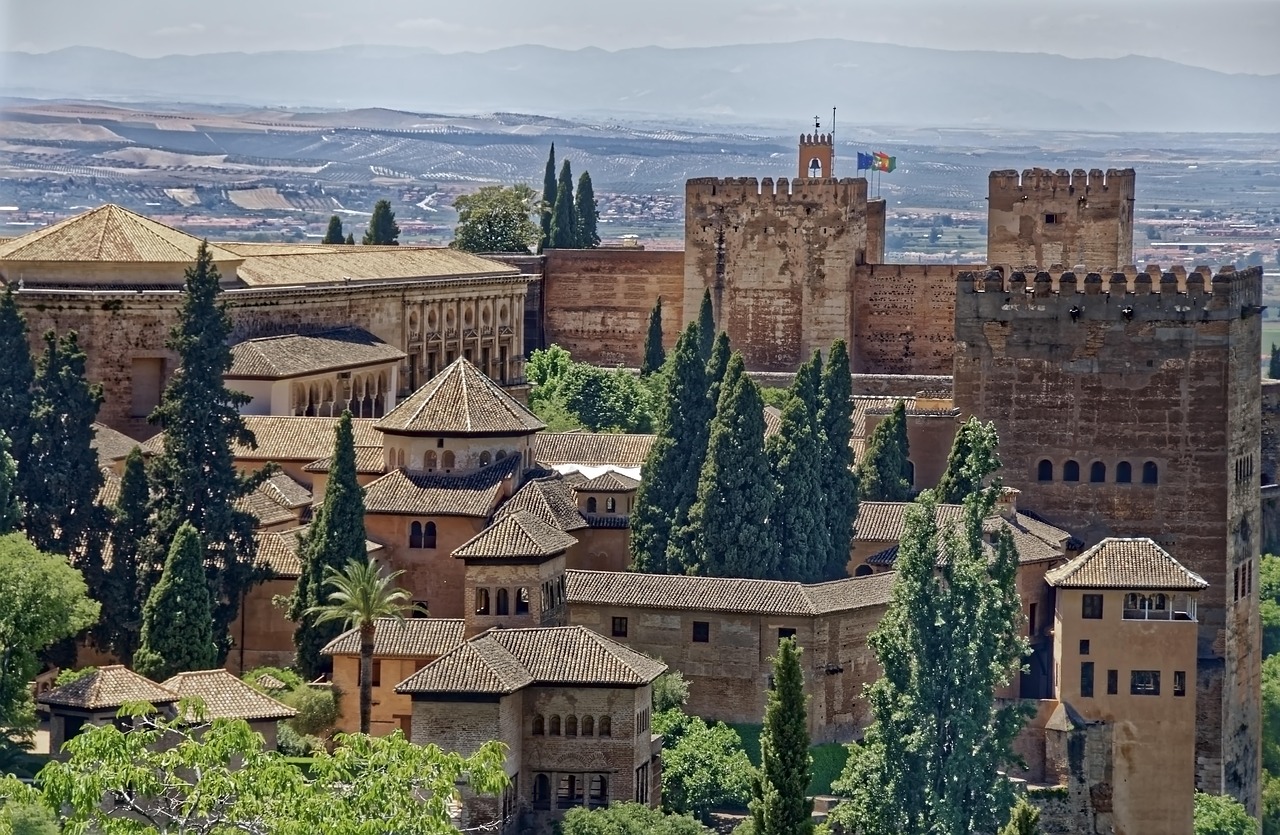
This is the heartbeat of the Alhambra. Do not rush this. The Nasrid Palaces are a sequence of courtyards and halls that represent the pinnacle of Islamic art in Spain.
As you enter the Mexuar, the administrative court, you’ll feel the temperature drop. The walls are covered in yesería (carved plaster) and ataurique (vegetal motifs). The light here is filtered, soft, and secretive.
Move into the Court of the Myrtles. In the center lies a long, rectangular pool that reflects the Comares Tower. If you are there early, the reflection is perfect, undisturbed by the crowds that will pile in by 10:00 AM. Look up. The wood ceiling is the oldest original in the Alhambra; it dates back to the 14th century. It is dark, geometric, and heavy.
Then, you enter the Hall of the Ambassadors. This is where the Sultan received dignitaries. The room is a dome of intricate geometry, star-shaped interlocking polygons that seem to float. It is mathematically perfect.
My Anecdote: I once stood in this room and watched a security guard gently shush a group of tourists who were speaking too loudly. The silence that followed was profound. You could hear the collective intake of breath. It is a room that demands reverence. It is also where, in 1492, Boabdil surrendered the keys of Granada to the Catholic Monarchs. You are standing on the exact spot where 700 years of Islamic rule in Spain ended. Let that sink in.
The Partal Palace: After the main palaces, do not skip the Partal. It is the oldest surviving residence (early 14th century). It has a terrace that looks out over the valley. The gardens here are lush, filled with nightingales (if you are lucky) and the hum of bees.
10:30 AM: The Generalife (The Architect’s Garden)
You will exit the Nasrid Palaces and face a choice: the Alcazaba (the military fortress) or the Generalife (the summer palace). Since you are on a tight schedule, head straight to the Generalife via the connecting path.
The Generalife is not about walls; it is about water. The name translates to "The Architect’s Garden." As you climb the stone steps, you will hear the water before you see it. The Patio de la Acequia is a long pool flanked by flowerbeds and plane trees. The irrigation system here is ancient and functional. It uses gravity to pull water from the Darro River, miles away, to cool the air in this valley.
In 2026, the gardens are in full restoration, but the main pathways are open. Walk through the "Water Staircase," where water cascades down banisters on both sides. It is cool, misty, and incredibly photogenic.
Generalife Logistics
Address: Calle Real de la Alhambra, 1, 18009 Granada, Spain.
Hours: 8:30 AM – 6:00 PM (Winter) / 8:00 PM (Summer).
Estimated Cost (2026): The Alhambra General ticket usually runs around €19-€22 for adults. Guided tours will push this to €50-€70. For a solo traveler, the audio guide app is sufficient, but a guided tour unlocks the history in a way the app cannot. If you have the budget, book a small group tour for the Nasrid Palaces only (approx. €60).
12:30 PM: The Exit and The View (Mirador de San Nicolás)
You will exit the Alhambra complex near the Alcazaba (the military fortress). Do not go down to the city yet. Instead, follow the signs for the Albaicín.
First, stop at the Mirador de San Nicolás. This is the most famous viewpoint in Granada. It is here that you get the iconic shot: the Alhambra set against the backdrop of the Sierra Nevada mountains. It is breathtaking. It is also incredibly crowded.
Pro Tip: Do not sit on the ground in the main square. The police will blow a whistle at you. Instead, walk five minutes further up to the Carmen de los Mártires or the Mirador de la Vereda de Enmedio for a slightly different, less chaotic angle.
01:30 PM: Lunch – Tapas in the Albaicín
You are now in the Albaicín, the old Moorish quarter. It is a labyrinth of narrow, winding streets called cármenes (houses with gardens). You are hungry. In Granada, you do not order a main course; you order drinks, and the food comes free.
Where to Eat
Head to Bar Los Diamantes (Calle Navas, 28). It is legendary. It is loud, chaotic, and the seafood is fresh. You order a caña (small beer) or a tinto de verano (red wine with soda), and you might get a plate of gambas pil-pil (sizzling shrimp in garlic oil) or fried anchovies.
If you want something more substantial and a seat at a table, go to Restaurante Cunini (Calderería Nueva, 12). They specialize in fish. It’s a bit pricier, but the quality is impeccable.
The "Free" Tapas Rule
In Granada, if you buy a drink (approx. €2.00 - €2.50), you get a tapa. It is not a bowl of olives. It is a full plate of food. You can technically make a meal of three drinks in three different bars. That is the "Ir de tapas" (Tapas Crawl).
Address (Bar Los Diamantes): Calle Navas, 28, 18009 Granada, Spain.
Hours: Typically 12:00 PM – 11:30 PM. Kitchens often close from 4:00 PM to 8:00 PM, but the bar stays open for drinks and small plates.
Price: Very reasonable. €15-€20 per person will get you full and happy.
03:00 PM: The Cathedral and the Royal Chapel
Walk down from the Albaicín towards the modern center. You are heading to Granada Cathedral and the Capilla Real (Royal Chapel).
The Cathedral is a Renaissance masterpiece. Unlike the Islamic intricacy you saw this morning, this is about soaring verticality and light. The main facade is heavy, but the interior is surprisingly bright, filled with gold leaf and massive columns.
However, the Royal Chapel is the heavy hitter. This is the final resting place of Queen Isabella I and King Ferdinand II (Los Reyes Católicos). Their coffins are heavy, bronze, and suspended in the air. It is a somber place. You can also see the tomb of their daughter, Joanna the Mad, who reportedly refused to leave her husband's side, even in death.
Chapel Logistics
Address: Calle Gran Vía de Colón, s/n, 18001 Granada, Spain.
Hours: Monday to Saturday, 10:00 AM – 6:00 PM (last entry 5:15 PM). Sundays and holidays, 11:00 AM – 2:00 PM.
Cost: €5.00 (Combined ticket for Cathedral and Chapel). Book online to skip the queue.
04:30 PM: The Sacromonte Caves and Flamenco
You cannot leave Granada without seeing the Sacromonte neighborhood. This is the Roma (Gypsy) quarter, famous for its cave dwellings (casas cuevas) carved into the hillside. It overlooks the Alhambra from the opposite side of the valley.
Take a taxi to the Sacromonte Abbey or the Centro Federico García Lorca. From there, you need to walk. The streets are steep and unpaved. Wear your best walking shoes.
Your destination is the Mirador de la Vereda de Enmedio or just wandering the Plaza de la Barrigona. The views here are different; you see the Alhambra from the side, perched on its red ridge.
If you have booked a Flamenco show (which you should do weeks in advance), this is where you go. Avoid the tourist traps in the Albaicín. Look for Cueva de la Rocío or Cueva de la Rubia. These are intimate, authentic venues. The music here is called Cante Jondo (Deep Song). It is raw, sorrowful, and intense. It is not a performance for a camera; it is an expression of life.
Flamenco Details
Address (Cueva de la Rocío): Calle Real de Sacromonte, 52, 18010 Granada, Spain.
Hours: Shows usually start at 8:00 PM or 9:00 PM.
Cost: Approx. €30-€40 including one drink.
06:30 PM: Sunset in the Albaicín (Round 2)
If you have energy left, head back to the Albaicín for sunset. The light turns golden, then purple, hitting the stucco of the Alhambra. The Call to Prayer (Adhan) may sometimes be heard from the minaret of the Iglesia de San José (formerly the great Mosque of Granada).
Find a Carmen (a house with a walled garden) that allows visitors. The Carmen de las Tomasas is a hotel, but they have a terrace bar that offers one of the best views in the city. Order a glass of wine and watch the red fortress turn into a silhouette.
08:30 PM: Dinner – Andalusian Soul
For your final meal, you need comfort. You need Carmen Santa Paula. Located in the Albaicín, this restaurant is set in a traditional Carmen. The food is rooted in Andalusian tradition but elevated.
Order the Ternera (veal) or the Habas con Jamón (broad beans with ham). The atmosphere is romantic, lit by lanterns and the scent of jasmine. It is the perfect way to end a day that began with the geometry of the Moors and ends with the warmth of modern Spain.
Dinner Reservation
Address: Calle Álamo del Marqués, 19, 18010 Granada, Spain.
Hours: 1:00 PM – 4:30 PM, 8:00 PM – 11:30 PM. Reservations are essential for dinner.
The Practicalities for 2026
Packing List & Clothing Tips
- Shoes: This is non-negotiable. You need shoes with arch support. The Alhambra is paved with uneven stones; the Albaicín is paved with slippery, polished cobbles. Leave the heels and the flip-flops at home. Bring broken-in hiking sneakers or sturdy loafers.
- Layers: Granada has a continental climate. Mornings are crisp (especially in spring/fall), midday is scorching, and evenings get chilly because of the altitude (738m). Pack a light windbreaker.
- Sun Protection: The sun at this altitude is deceptive. Even in October, you can burn. Sunglasses and a hat are mandatory.
Parking near Alhambra and Albaicín
Do not attempt to drive up to the Alhambra. The parking garages are expensive and spaces are tight.
- Best Option: Park at Plaza Nueva (Plaza Nueva, s/n). It is underground, secure, and you can buy a 24-hour ticket. From here, you can walk up to the Alhambra or catch the bus. It costs roughly €1.80 per hour, with a daily max around €18-€20.
- Alternative: Parking Gran Vía (Gran Vía de Colón, 34). Closer to the Cathedral but further from the Alhambra ascent.
Crowd Avoidance (2026 Strategy)
- Best time to visit: Late September to early November. The summer crowds have dissipated, the light is golden, and the Sierra Nevada might have a dusting of snow on the peaks.
- The "Early Bird" Rule: Be at the ticket office at 8:00 AM. The first hour at the Alhambra is the only time you will feel like you have the place to yourself.
The "Alhambra-First" Philosophy
Why structure a day this way? Why not wander aimlessly?
Because the Alhambra is a jealous mistress. If you leave it for later, if you try to "warm up" with a coffee in the Plaza Nueva and "maybe head up around 11," you will find yourself in a line of 2,000 people. You will be hot, tired, and the magic will be suffocated by the sheer volume of humanity.
By tackling the Alhambra first, you claim the experience. You see the Nasrid Palaces while the morning mist still clings to the cypress trees. You walk the Generalife gardens while the air is still cool. You earn the rest of your day.
When you finally sit down for dinner in the Carmen de Santa Paula, your legs will ache, your feet will throb, and your phone storage will be full. But your mind will be echoing with the geometry of the past. You will have seen the Red Fortress in the morning light, the Sierra Nevada at sunset, and you will have tasted the salt and garlic of the earth.
Granada is a city of layers. In one day, you can peel them back, just a little. It is a heavy, rich, overwhelming feast. But if you follow this itinerary, you won't just survive it—you will savor it.
And tomorrow morning? Tomorrow morning, you can sleep in. You've earned it.